EXHIBITION
- PAST EXHIBITION

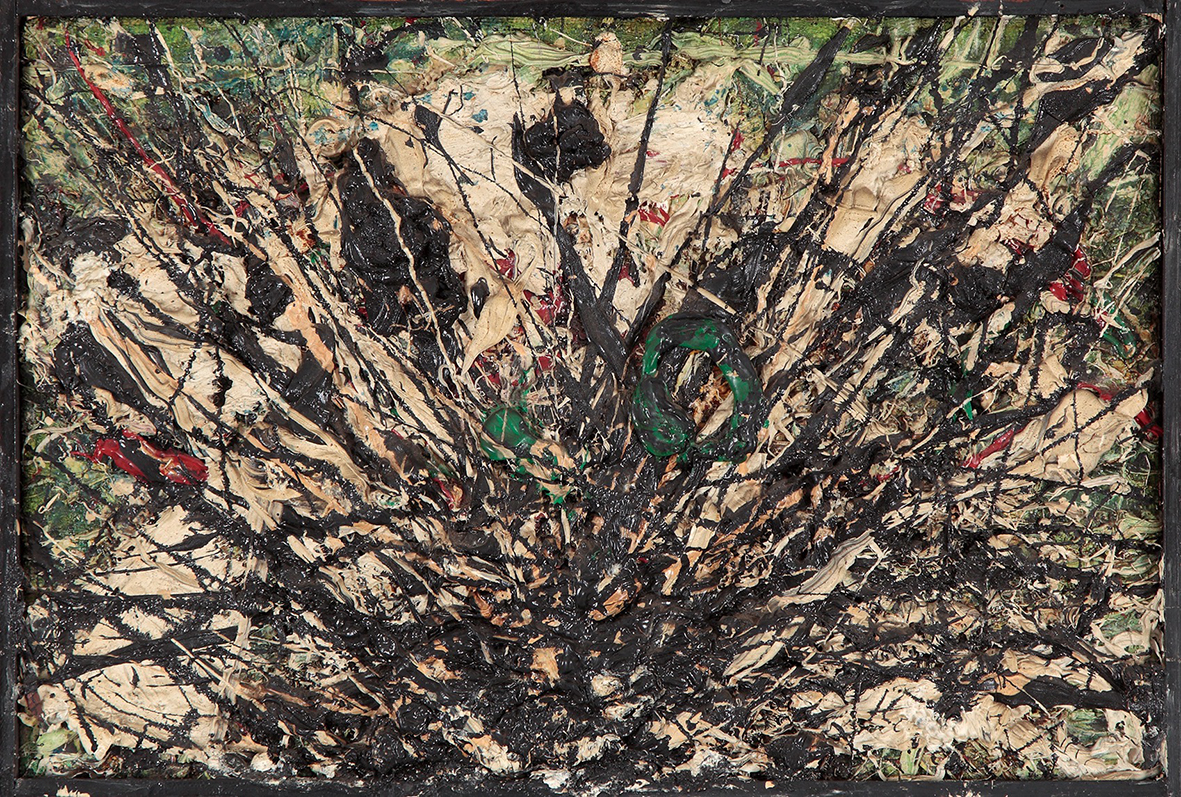
WORK / 197 x 297 cm / Acrylic on canvas / 1970s / Signed
- Toshimitsu Imai Solo Exhibition
- 2026.04.11 Sat - 2026.05.09 Sat
Toshimitsu Imai Solo Exhibition
STANDING PINE is pleased to present a solo exhibition of Toshimitsu Imai (1928–2002), one of the key figures of postwar Japanese art, opening on Saturday, 11 April 2026.
Born in Kyoto in 1928, Imai studied for one year in the Oil Painting Department at Tokyo University of the Arts before relocating to France in 1952. In Paris, he developed close relationships with artists such as Sam Francis and the influential critic Michel Tapié. Immersed in the currents of Art Informel, he established a dynamic mode of abstraction characterised by dense materiality and a vibrant, expressive use of colour. In 1956, following a request from Tarō Okamoto, Imai assisted in arranging the presentation of works from Michel Tapié’s collection for The World: Art of Today, organised by The Asahi Shimbun and held at venues including Nihonbashi Takashimaya. Through this involvement, he played an important role in introducing Art Informel to Japan.
Against this background, the thickly worked surfaces and forceful brushwork that characterised Imai’s paintings of the 1950s gave way in the 1970s to broader, more pared-back strokes, generating a renewed sense of structure. Within this shift, a move away from material excess towards greater refinement became increasingly apparent in brushstrokes that seem to tear through decentred compositions, as seen in works such as Black and Untitled. Described in Europe at the time as “Oriental calligraphy”, these sign-like brushstrokes marked for Imai both a critical turning point within Art Informel and the beginning of a transition that would later lead to his Ka-Chō-Fū-Getsu series.
At the same time, the 1970s also marked a period in which, building on his experience of Art Informel, Imai began to reconsider his artistic practice within a broader cultural framework. At Expo ’70 Osaka, he took on the role of art director for one of the corporate pavilions while also expanding his practice to include mural projects as well as collaborations with fashion and music. As Imai himself wrote, “What matters to me is not painting, but culture”. His work and broader artistic vision, therefore, cannot be understood simply as a stylistic evolution; rather, it constituted an attempt to expand the field of expression while moving between Japanese and Western contexts, and between abstraction and culture.
This exhibition invites viewers to rediscover the singular character of Imai’s practice beyond the framework of Art Informel through a selection of works emerging from his sustained experimentation.
We look forward to welcoming you to the exhibition.
Date: Saturday, 11 April – Saturday, 9 May
Hours: 12:00 – 18:00 (From Tuesday to Saturday)
Closed on Sundays, Mondays, and national holidays
Opening reception: Saturday, 11 April, 17:00 – 19:00
Work / Oil on canvas / 33 x 22 cm / 1959 / Signed
Biography
Born in Kyoto in 1928, Toshimitsu Imai studied for one year in the Oil Painting Department at Tokyo University of the Arts before relocating to France in 1952. During his time in Paris, he developed close relationships with artists such as Sam Francis and the influential art critic Michel Tapié. Immersed in the movement of Art Informel, Imai developed a dynamic mode of abstraction characterised by dense materiality and a vibrant, expressive use of colour.
In 1956, at the request of Tarō Okamoto, Imai was involved in coordinating the inclusion of works from Michel Tapié’s collection for The World: Art of Today exhibition, organised by The Asahi Shimbun and held at venues including Nihonbashi Takashimaya. The exhibition marked the first major introduction of Art Informel painting to Japan and generated significant critical attention, becoming a key moment that shaped its subsequent reception.
From the 1960s onwards, Imai continued to work between Japan and France, establishing his international reputation through participation in major exhibitions such as the 30th Venice Biennale (1960) and the 7th Bienal de São Paulo (1963). At Expo ’70 Osaka, he served as art director for a corporate pavilion. In the 1980s, he developed the Ka-Chō-Fū-Getsu series, incorporating gold and silver leaf and engaging with elements of traditional Japanese painting. In later years, he also addressed themes confronting the devastation of war, notably in his Hiroshima series.
Imai’s works are held in numerous public collections, including The National Museum of Modern Art, Tokyo; The National Museum of Modern Art, Kyoto; The National Museum of Art, Osaka; Museum of Contemporary Art Tokyo; Aichi Prefectural Museum of Art; Hyogo Prefectural Museum of Art; and Shiga Museum of Art, among others.
Powered by Froala Editor