EXHIBITION
- CURRENT EXHIBITION
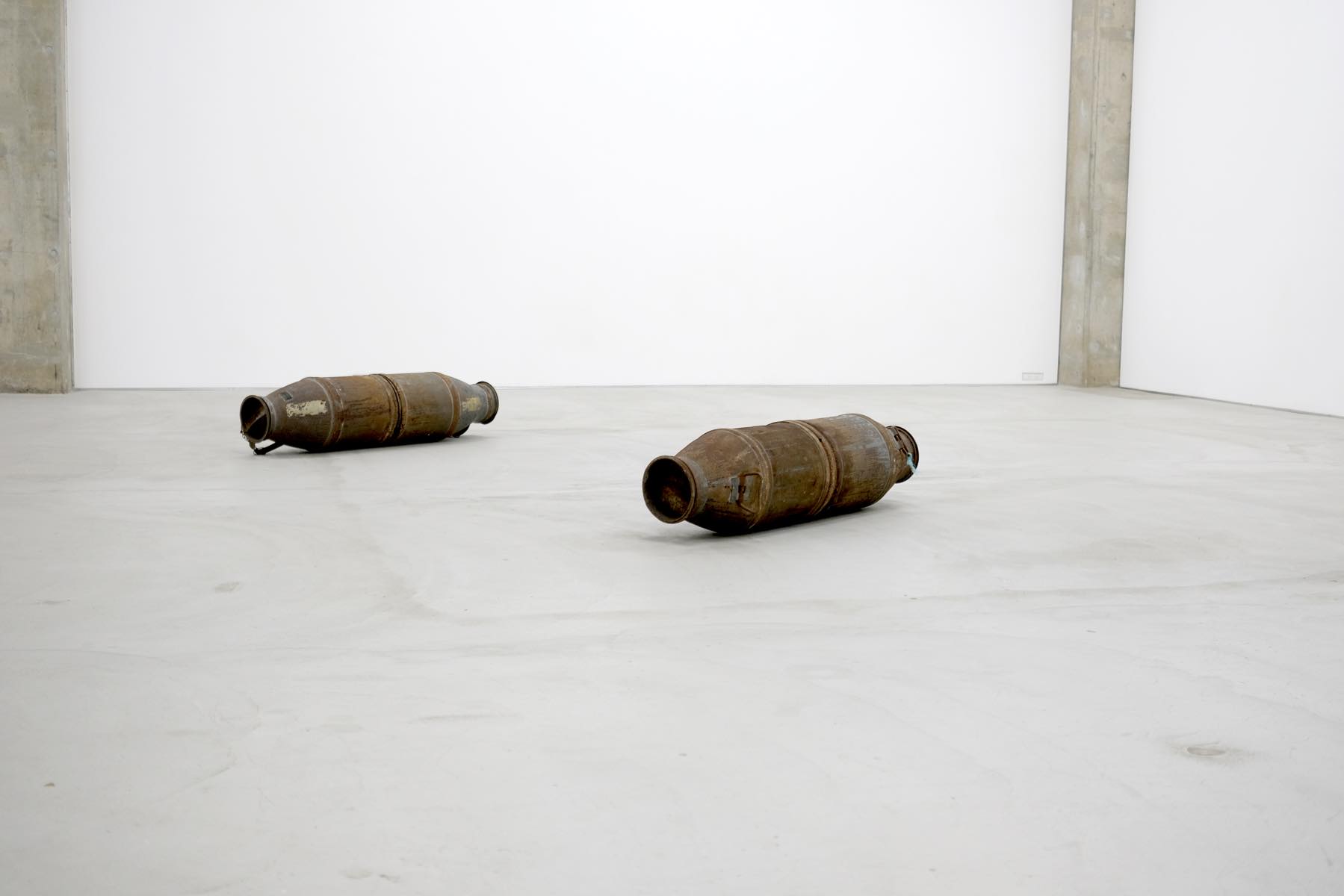
Intolerance / 2025 / Old milk can / 1200mm×300mm
- Youki Hirakawa
- Intolerance
- 2026.09.19 Sat - 2026.10.17 Sat
STANDING PINE is pleased to present Intolerance, a solo exhibition by Youki Hirakawa, opening on Saturday, 19 September 2026.
Hirakawa creates works that read the information embedded within everyday objects, excavating the histories and political dimensions that emerge from them. In this exhibition, he examines the process by which institutions, values, and ways of life—brought to Japan primarily from the United States after World War II—were accepted and became established within Japanese society, linking this process to his own memories and physical experiences, and framing it as an issue that continues to the present day.
Intolerance / 2025, from which the exhibition takes its title, is constructed from two old milk churns combined to resemble an unexploded bomb. In post-war Japan, powdered skimmed milk supplied as aid, together with the widespread introduction of school lunches centred on bread and milk, brought significant changes to the Japanese diet. Hirakawa examines this Westernisation of food not only in relation to the policies of the Occupation, but also through the lens of biopolitics, considering state-led nutritional management and intervention in the body. From there, his enquiry extends to what he describes as a form of “food colonialism”.
The work was prompted by the discovery, in 2023, of an unexploded bomb near Hirakawa’s home in Nagoya. This incident brought together two memories from his childhood on the Atsumi Peninsula: the unexploded ordnance he had seen there, and the rusted milk churns that remained in cowsheds. Out of this convergence emerged Intolerance / 2025. The term “Intolerance” not only refers to lactose intolerance as a physiological condition but also prompts us to question what we have taken for granted through the changing landscape of our eating habits. Taking the transformation of dietary habits as its point of departure, the work asks what we have come to accept as self-evident.
In Souvenir / 2025, Hirakawa enlarges a postcard depicting a Japanese squat toilet photographed during the Occupation and reorients the image horizontally, transforming the toilet into an image resembling a urinal. Recalling Marcel Duchamp’s Fountain, the work brings into view the external gaze directed towards Japanese everyday culture at the time, while also drawing attention to forms of life and cultural identity that are gradually disappearing through processes of social transformation. At the same time, it proposes a rereading, from an Asian perspective, of the frameworks through which contemporary art has largely been shaped in the West. The work embodies a critical sensibility that Hirakawa describes as “self-deprecating dark humour”.
For Intended Accidental Ingestion / 2026, Hirakawa ingested the tip of a projectile fired from a 9mm round that he acquired at a flea market. After passing through his body, 69 hours and 44 minutes later, it was incorporated into the work. Confronted with the situation surrounding US military bases in Okinawa, and Japan’s deeply entangled relationship with the US military from the post-war period to the present, Hirakawa attempts to take in—through the physical act of literally “swallowing”—a reality for which no simple answer can be found. Blackened by gastric acid after passing through his body, the projectile is presented together with an upturned piece of US military surplus furniture, a glass tumbler, and a tin ashtray stamped “Made in Occupied Japan”.
Through these works, Intolerance approaches from different angles the ways in which the past remains inseparable from the present, continuing to act upon our everyday lives. We invite you to encounter Youki Hirakawa’s practice, which brings to the surface the histories embedded in ordinary life and the political structures that lie beneath them.
Dates: Saturday, 19 September – Saturday, 17 October 2026
Hours: 12:00–18:00, Tuesday to Saturday
Closed: Sundays, Mondays, and national holidays
Opening Reception: Saturday, 19 September, 17:00–19:00 (the artist in attendance)
----------------------------------------------------------------
CV
Youki Hirakawa
Born in Nagoya in 1983, Youki Hirakawa moved to Germany in his late twenties to pursue his artistic practice, returning to Japan in 2016 after being caught up in an attempted terrorist attack in Berlin. He is currently based in Gifu Prefecture. In recent years, his practice has increasingly focused on the political dimensions embedded within everyday objects.
His major presentations include invited screenings at the International Film Festival Rotterdam, the Netherlands, and the International Short Film Festival Oberhausen, Germany. His work has also been presented a ArtScience Museum, Singapore; Tikotin Museum of Japanese Art, Israel; Sheffield Museums, UK; Moscow Museum of Modern Art, Russia; Vyatka Art Museum, Russia; National Taiwan Museum of Fine Arts, Taiwan; National Archives of Singapore; Salisbury Cathedral, UK; Durham Cathedral, UK; Pola Museum of Art, Japan; Okazaki Mindscape Museum, Japan; and The National Art Center, Tokyo.
----------------------------------------------------------------
Indigestion, or On Keeping Things Undigested
Tomoya Iwata
Digestion. It is the body’s process of breaking down and absorbing what we take in, transforming it into a part of ourselves. Yet not every substance can be digested. What the body cannot accommodate remains as foreign matter, causing pain and discomfort before eventually being expelled. Indigestion is, in this sense, a state in which the distance between oneself and the other that has been taken in cannot be erased: a failure to make that other part of oneself.
In his solo exhibition Intolerance, Youki Hirakawa confronts those things that remain other to him, together with the memories and histories bound up with them. Through his own body and memory, Hirakawa attempts to reassess his distance from things that have already been taken in, yet remain impossible to fully assimilate.
Occupying the centre of the space is Intolerance, the work from which the exhibition takes its title. Unexploded bombs dropped during US air raids continue to be discovered across Japan more than eighty years after the war. Having lain buried in the ground for decades, they still retain the potential to detonate and must be dealt with one by one. Buried within invisible strata, resistant to decomposition by the soil, these relics of war remain alongside our everyday lives. Hirakawa reconstructs their form using rusted milk churns of the kind he encountered in a cowshed that served as his childhood playground.
Milk, too, was a foreign substance taken into the body of postwar Japan. Introduced through school lunches, it became familiar to people across the country from childhood onwards, despite the relatively low prevalence of genetic lactose tolerance among East Asian populations, often resulting quite literally in indigestion. Yet the spread of milk in Japan is said to have been shaped by GHQ policy during the Allied occupation, together with US export strategies and the calculations of the Japanese government. Systems and values introduced from outside intervene in the body, only to manifest from within as stomach pain and physical discomfort. The superimposition of the unexploded bomb and the milk churn suggests that postwar American influence is not simply a thing of the past, but continues to operate through dietary habits and bodily sensation.
In Souvenir, a postcard photograph of a Japanese-style toilet taken during the Allied occupation of Japan is enlarged and displayed on its side. Captioned “JAPANESE TOILET (BENJO)”, the image, when rotated ninety degrees, comes to resemble a Western-style urinal. This reorientated photograph inevitably evokes the iconic image of Marcel Duchamp’s Fountain. Yet whereas Duchamp altered the orientation of a urinal, displacing it from its intended function and meaning, Hirakawa rotates an image of a Japanese squat toilet so that it comes to resemble a urinal. In doing so, he appears to reverse the exoticising gaze once directed at occupied Japan, turning it back upon the Western-centric canon of contemporary art.
In Intended Accidental Ingestion, Hirakawa’s attempt to digest history quite literally fails. At the centre of the work is a spent 9 mm projectile of the type used in the Beretta M9, a standard-issue sidearm of the US military. Hirakawa swallows the projectile in an attempt to bring the issue of US military bases in Japan—a matter in which he is implicated as a Japanese person, yet from which he remains somewhat removed—closer to his own body, so that he might figuratively chew over the issue for himself. Yet rather than becoming part of his body, it is excreted around three days later, blackened by gastric acid. This fact suggests that the issue is not one that can readily be “digested” by any one individual.
At the same time, the “Japanese person” who swallows the bullet cannot be understood as a monolithic entity. Japan, while itself subject to American occupation and military influence, also bears responsibility for having concentrated that burden in Okinawa. Japan has thus unevenly distributed within its own borders the indigestible violence received from the United States, with particular regions made to swallow it.
Kuan-Hsing Chen distinguishes between “decolonisation,” through which the colonized re-examine their historical relationship with the colonizer, and “deimperialization,” through which former colonizers reflect upon the harm they themselves inflicted. In postwar Japan, what was needed was not only a re-examination of its subordinate relationship with the United States, but also a reckoning with the imperialism Japan itself had exercised across Asia and a reconfiguration of its relations with its former colonies. Under GHQ governance, however, the opportunity for such reflection was cut off.* In this sense, one might say that Japan has arrived at the present unable fully to digest not only America, but also the history of its own empire.
Perhaps, then, what demands our attention is not the act of digestion, but the fact of being unable to digest: the condition in which something cannot be incorporated as part of oneself. In the exhibition Intolerance, Hirakawa addresses multiple forms of “indigestion”. Yet these are not merely failures. Rather, might they be responses from the body—reminders that histories which cannot easily be assimilated or forgotten remain very much with us, compelling us to continue chewing them over and reflecting upon them?
* Kuan-Hsing Chen, Asia as Method: Toward Deimperialization (Durham, NC: Duke University Press, 2010),
Author Biography
Tomoya Iwata
Tomoya Iwata (b. 1995, Aichi) is a curator and the representative director of The 5th Floor, a curatorial space in Tokyo. He completed his MA at the Graduate School of Global Arts, Tokyo University of the Arts. Through on-site research, Iwata frequents alternative spaces in various cities mainly in Asia to further understand the dynamics between institutional and alternative art scenes in their individual contexts. As a practitioner who operates such a space himself, he explores the potential for alternatives to existing systems through curatorial practices beyond exhibition-making.

Souvenir / 2025 / Reprint of an old postcard / 1800mm×1200mm
Powered by Froala Editor